CAPTAIN

Conservation Area Prioritization
Through Artificial INtelligence

Spatial conservation and restoration planning using reinforcement learning

CAPTAIN 3.0 is coming

  • Complete rewrite for high performance: Significant efficiency improvements and full GPU support enable analysis at larger scales and finer resolutions.
  • Dynamic environment scenarios: Advanced support for time-evolving scenarios, incorporating climate change projections and dynamic implementation costs.
  • Modular & Customizable: A flexible framework allowing for highly tailored conservation policies and easier integration of custom data.
  • Multi-objective optimization: Full support to quantify synergies and trade-offs between competing conservation and restoration targets.
  • Enhanced Documentation: Comprehensive technical guides and examples to streamline the implementation of complex workflows.

How do we best protect biodiversity in a rapidly changing world and with limited resources?

Over a million species face extinction, carrying with them untold options for food medicine, fibre, shelter, ecological resilience, aesthetic and cultural values. We urgently need to design conservation policies that maximize the protection of biodiversity and its contributions to people, within the constraints of limited budgets.
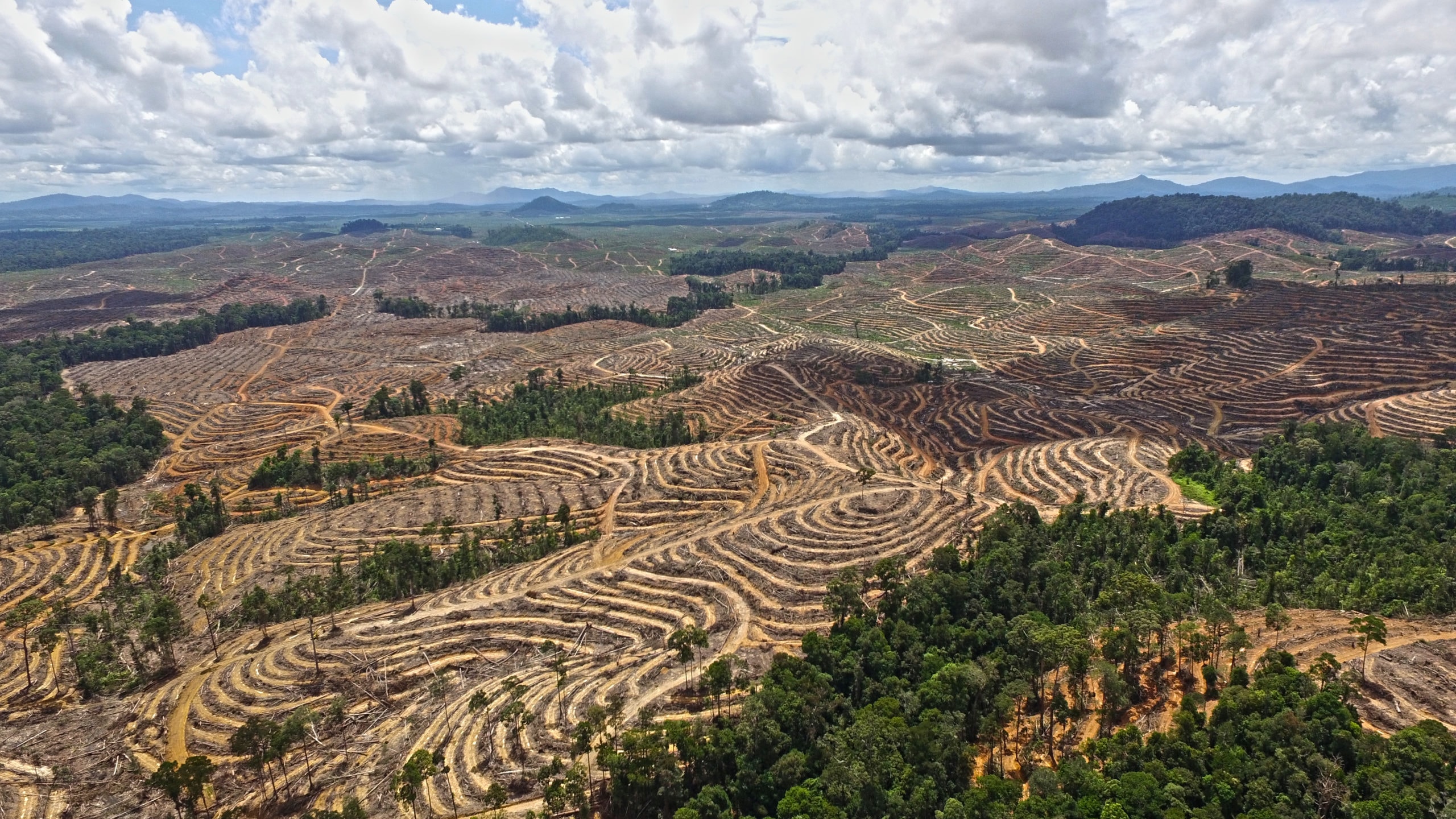
Forestry

Harnessing the power of AI to optimize conservation efforts

We use reinforcement learning to train models for conservation prioritization that best use the available data and resources. CAPTAIN models can work with basic species distribution data but can handle complex multidimensional data and their temporal trends, including land use and climate change.
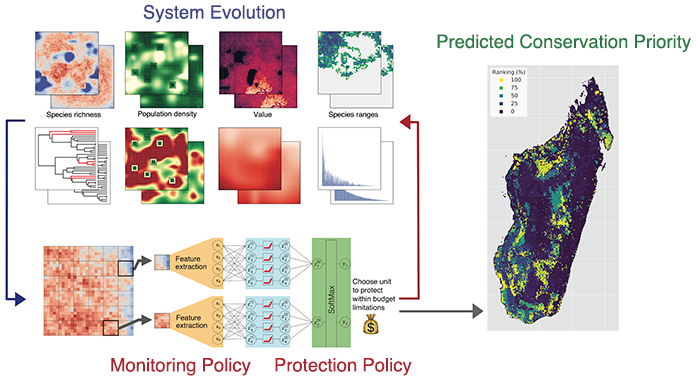
Captain flow

A simulated natural system

CAPTAIN uses simulations based on an individual-based spatially explicit model of biodiversity to train policies through Reinforcement Learning.

Species richness

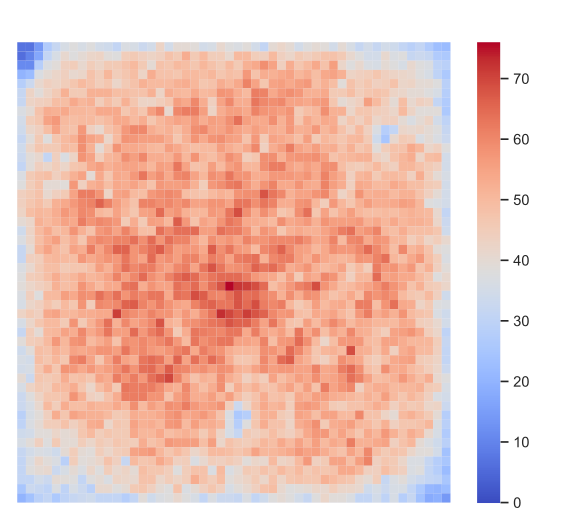
Species richness and its evolution through time. After monitoring the system for 3 iterations CAPTAIN's agent establishes protected units (outlined in black) based on a policy optimized to minimize biodiversity loss. The number of protected units is constrained by a predefined budget.

Species richness

Population density

Species rank-abundance

Phylogenetic diversity

Anthropogenic disturbance

Climate

Economic loss

Variables through time

Species A

Species B

Species C

Species D

Download

CAPTAIN v.2 is available on GitHub.

Join the community

Ask questions on GitHub Discussions.